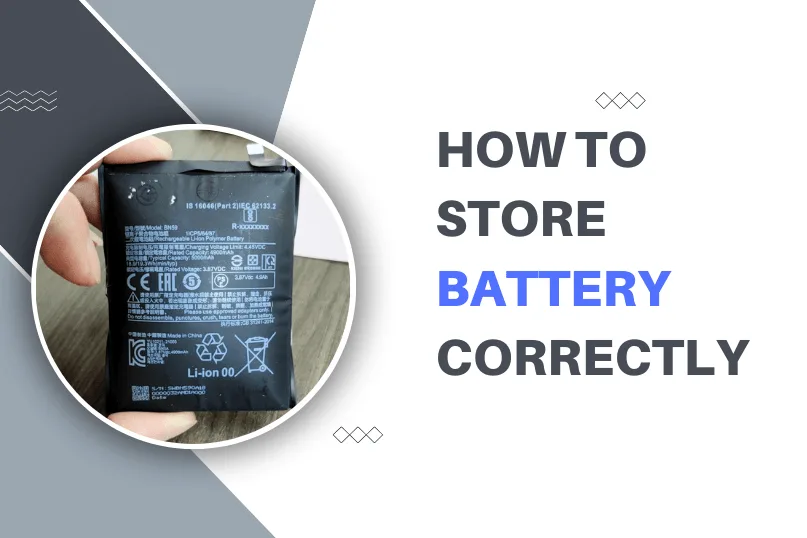
Some repair shops and distributors, due to the lack of professional purchasing guidance, fail to monitor storage temperature and humidity after purchasing batteries and cells in bulk, and also fail to charge the batteries in time. These wrong storage methods may result in battery failure after being stored for more than 3 months, such as poor voltage, battery bulging, etc., which will cause unnecessary losses.
Today, REWA shares battery storage and precautions, along with ways to recharge them, to help you store batteries and cells correctly, thereby save operating costs.
Why Should Batteries Be Stored Properly?
Lithium batteries are commonly used in phones, tablets, and other electronic devices. There are strict requirements for the storage of lithium batteries in terms of temperature and humidity. In terms of battery charging and discharging, temperature has the greatest influence among all environmental factors.
Lithium batteries’ electrochemical reactions are related to ambient temperature. Firstly, if the temperature is too low, the battery will lock and there will be no voltage output. Battery lock means that when battery power drops to an extremely low state, the battery will automatically lock to protect battery health and user safety. Secondly, excessive temperatures will accelerate the battery’s self-discharge rate, which is not conducive to long-term storage.
Additionally, lithium batteries cannot be left in a low-power state for an extended period of time, which will result in a reduction in battery life, and it is irreversible. For this reason, it is necessary to maintain the battery’s performance by checking its voltage every three months as well as performing charge and discharge cycles if necessary.
How to Store Batteries Correctly?
If distributors or repair shops purchase batteries and cells in bulk, we recommend that they build a dedicated warehouse for storing batteries and cells in the following manner:
| Classification | Description |
| Storage Temperation | ≤1 month 0~45℃ |
| ≤3 month 0~30℃ | |
| Storage Humidity | 65±20% RH |
| Storage and Transportation | 1. The Battery should be stored at a dry moisture, dustproof, shockproof , core packaging. |
| 2. The Battery shall be stored at a clear ,dry and ventilated room, should avoid contact with corrosive substances, should away form fire and heat. | |
| 3. The Battery should avoid strenuous vibration, impact and pressure in the transport, and need avoiding the strong direct sunlight and under the raining. | |
| 4. The storage time of batteries in normal temperature (20±5℃) environment is 6 months. Batteries must be charged once for more than 6 months. The charging current is recommended to be 0.1C 5A. | |
| Notice | 1. The Battery shall be discharged used the specific charger. |
| 2. Do not immerse the Battery in water or liquid,needing keep off moisture. | |
| 3. Avoid using the battery near a heat source,such as fire and heater. | |
| 4. Do not reverse the polarity of the Battery for any reason | |
| 5. Do not disassemble the Battery. The disassembling may cause a chance to generate internal short circuit in the Battery. Which may cause gassing, firing, explosion or other troubles. And it can lead the electrolyte leakage, which is harmful to health. If the Electrolyte fluid into your eyes or other parts of the body , rinse with water as soon as possible, and quickly sent to hospitals. | |
| 6. Never make short circuit the Battery. It makes generation of very high currents which subsidiary cause heating of the Battery which may cause the electrolyte leakage, gassing or explosion which are very dangerous. | |
| 7. Do not deal with the waste battery by fire, otherwise it may cause the dangerous accident , such as explosion. | |
| 8. If any abnormal features of the Battery are found such as damages in a plastic envelop of the Battery, deformation of the Battery package, smelling of an electrolyte, an electrolyte leakage and others, the Battery shall never be used any more. And The Battery with a smell of the electrolyte or a leakage shall be placed away from fire to avoid firing or explosion. |
How to Recharge Batteries and Cells?
To maintain battery performance, REWA recommends testing battery voltage every 3 months. If the voltage is too low, the battery needs recharge.
Recharge Steps:
- Use Multimeter to check batteries’ voltage.
- Use Battery Charge Activation Board and DC Power Supply to recharge batteries.
Guidelines:
- Please store batteries according to the supplier’s product instructions to ensure a safe voltage level. Different batteries may have different standard voltage levels.
- When the battery voltage drops below the safe threshold, it is imperative to recharge it promptly and safely.
- Note that deeply discharged batteries subjected to high-current charging may overheat, swelling, or damage. Therefore, for safe recharging, it is recommended to combine trickle charging with regular charging.
Please be aware that recharge operations require expertise. If needed, please contact REWA for customized recharge solutions. REWA provides both individual and bulk recharge solutions for batteries and battery cells.
Contact now: +852 5167 5273 /sales@rewa.tech.

Summary
The batteries and cells used in electronic devices, including mobile phones, tablets, smart watches, etc., are consumables with a limited lifespan. They can usually be charged and discharged 300-500 times. Thus, mastering the optimal storage method is equivalent to extending the battery’s life and ensuring that your investment will yield a greater return.


 English
 Español
 Français
 Deutsch
 Italiano